Tennisin60 Editorial
Prepared with AI assistance.
The story of the grass-court major, with recent men’s and women’s winners, career-changing breakthroughs, trivia, published 2027 ticket prices and practical London travel advice.
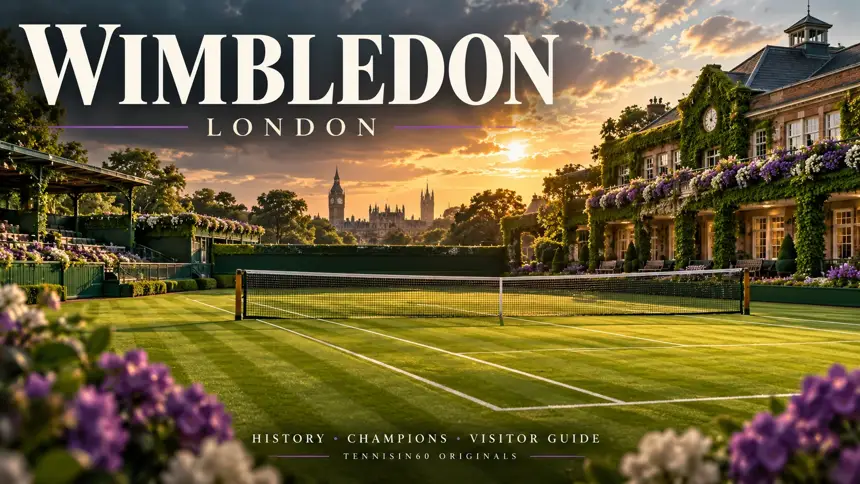
Wimbledon is the major that can feel familiar before you have ever walked through its gates. The white clothing, green courts, purple accents and quiet before a serve are among the most recognisable images in sport. Yet the real tournament is considerably richer than its television shorthand. It is a place where a visitor can watch a future champion from a few metres away, study a doubles team's movement and then join thousands of people following Centre Court on a hillside screen.
This Tennisin60 guide explains the Championships as both a sporting institution and a trip you can actually plan. Its history matters, but so do the practical differences between a Grounds Pass, a reserved seat and a hospitality package. Knowing those differences can save more money than searching for an apparently cheap ticket without understanding its restrictions.
Visitor information reviewed on October 25, 2026. Wimbledon 2027 is scheduled for June 28–July 11. The 2027 Public Ballot has closed; other ticket routes have their own eligibility rules and availability. This guide separates dated face-value prices from live availability and premium packages. Historical coverage includes the completed 2026 singles championships. [8][9][16]
Wimbledon at a glance
| Item | What visitors should know |
|---|---|
| Official name | The Championships, Wimbledon |
| Category | Grand Slam, with men's and women's events |
| Next Championships | June 28–July 11, 2027; check the official dates page [16] |
| 2027 Public Ballot | Closed as of October 25, 2026; follow official ticket updates [9] |
| Location | All England Lawn Tennis Club, Church Road, Wimbledon, London |
| Main surface | Grass |
| First Championships | 1877; women's singles began in 1884 |
| Modern home | Church Road since 1922 |
| Main show courts | Centre Court and No.1 Court, both with retractable roofs |
| Main ticket routes | Public Ballot, authorised sales, The Queue and on-site ticket resale |
| Currency | British pounds, GBP |
| Official information | Wimbledon |
Why Wimbledon still feels different
The tournament's greatest strength is that it makes small rituals feel consequential. A player brushing the baseline with a shoe, a ball child waiting motionless and an umpire asking spectators to settle can all become part of a much larger drama. On television these details sometimes look ceremonial. Beside a court, they reveal how tennis depends on managing space, timing and attention.
There is also an important contrast between the main arenas and the outside courts. Centre Court offers scale, history and an unusually focused atmosphere. A smaller court offers proximity: you hear the adjustment steps before a return, see the height of a defensive slice and notice how quickly a player recovers after contact. A good Wimbledon day can contain both experiences, but it does not have to.
For coaches and parents, that makes Wimbledon more than a trophy pilgrimage. It is a chance to watch decisions without the editing of a highlights package. A junior can see that an exceptional player still mistimes balls, changes plans and accepts imperfect points. The lesson is often less about copying a spectacular winner than understanding the disciplined work that makes one possible.
From a croquet club to a world championship
The first Championships were staged in 1877 at the club's earlier Worple Road grounds. Spencer Gore won the gentlemen's singles. Women's singles and men's doubles joined the programme in 1884, with Maud Watson becoming the first women's champion. These beginnings were much smaller than the modern event, but they helped establish a competitive structure for a young sport still refining its rules and identity.
Early champions did not all negotiate the same tournament format used today. For many years the defending singles champion could wait in the challenge round while other entrants contested the right to face them. Comparing title totals across eras therefore requires context. Winning repeatedly was still an achievement, but the route through a championship was not identical to winning seven successive main-draw matches in a modern 128-player field.
The club moved to Church Road in 1922, the same year the challenge-round system ended at Wimbledon. That change is a useful dividing line in the event's history. The new setting offered room for growth, while the competitive format moved closer to the principle contemporary fans expect: the champion must enter the tournament with everyone else and keep winning until the final.
The amateur era and the opening of tennis
Wimbledon helped make international tennis famous long before professionals were allowed into its main championships. Suzanne Lenglen, Helen Wills Moody, Bill Tilden, the French Musketeers and Fred Perry brought contrasting styles and personalities to a sport whose global reach was expanding. Their achievements belong to the record, even though the relationship between amateur status, expenses and earning a living was very different from today's tour.
The Open era began in 1968, allowing professionals and amateurs to compete together at the major championships. Rod Laver and Billie Jean King won that year's Wimbledon singles titles. This was more than a change in terminology. It brought leading players back into a shared competitive arena and helped create the professional sport that modern audiences recognise.
A visitor interested in history should resist the temptation to reduce everything before television's modern era to sepia photographs. Changes in rackets, training, travel and access altered who could compete and how the game was played. The historical appeal lies partly in those differences. Wimbledon offers continuity, but its champions have repeatedly forced the tournament to accommodate new kinds of tennis.
Grass: the surface behind the reputation
Wimbledon is the only one of the four majors currently played on grass. The club describes its playing grass as being cut to eight millimetres during the Championships. That precise maintenance detail should not be confused with a simple explanation for every bounce. Weather, wear, court firmness, ball condition and the way a player strikes the ball all contribute to what spectators see.
Grass often rewards a strong serve, an efficient first movement and the ability to handle a lower contact point. However, modern Wimbledon is not exclusively a serve-and-volley contest. Excellent returners and baseliners have won by managing the first few shots, redirecting pace and making opponents play one more difficult ball. The surface changes the questions; it does not provide only one acceptable answer.
When you watch, pay attention to the receiving player's posture and the length of the first backswing. A blocked return that lands deep may be more valuable than a spectacular attempt that misses. Watch how players approach a short ball and whether they move forward after creating an advantage. These are practical patterns a recreational player can study without trying to reproduce a professional's racket speed.
The champions who shaped the men's event
Björn Borg's five consecutive titles from 1976 to 1980 challenged the idea that grass belonged only to net-rushers. John McEnroe brought extraordinary touch and geometry. Boris Becker's 1985 victory, at seventeen, made a teenager's attacking tennis a worldwide story. Pete Sampras then established an era in which serve placement, athletic movement and calm under pressure became the defining combination.
Roger Federer won eight Wimbledon singles titles, a men's record through the 2026 edition. His success was not simply decorative elegance: it depended on an excellent serve, a forehand that controlled court position and the ability to make quick adjustments. Rafael Nadal's victory over Federer in 2008 showed how forcefully a great baseliner could impose himself on grass, while Novak Djokovic built his own Wimbledon legacy around return quality, balance and resilience.
Andy Murray's 2013 title ended Britain's long wait for another men's singles champion after Fred Perry. Carlos Alcaraz won in 2023 and 2024. Jannik Sinner followed in 2025 and successfully defended the title against Alexander Zverev in 2026. These different champions make the same point: Wimbledon rewards adaptation, rather than a single frozen version of how grass-court tennis should look.
The women who made Wimbledon their stage
Martina Navratilova's nine singles titles remain the women's benchmark. Her game joined athletic preparation, left-handed serving patterns and an instinctive commitment to the net. Steffi Graf's seven titles showed a different combination: an attacking forehand, a penetrating slice backhand and exceptional movement. Their rivalry is a valuable reminder that a surface can reward contrasting solutions to the same tactical problem.
Venus and Serena Williams changed expectations of first-strike tennis. Venus won five Wimbledon singles championships and Serena seven. Both combined serving power with reach, movement and competitive nerve. Their matches also brought new audiences and a different cultural significance to a tournament frequently associated with older traditions.
The recent women's champions have been especially varied. Ashleigh Barty's slice and all-court game, Elena Rybakina's serving, Markéta Vondroušová's left-handed variation, Barbora Krejčíková's composure and Iga Świątek's emphatic 2025 run all belong to the story. In 2026 Linda Nosková defeated Karolína Muchová in an all-Czech final. A guide to Wimbledon should give the women's competition the same historical attention as the men's, rather than treating it as an appendix.
Recent Wimbledon singles winners, 2010–2026
This is a recent champions table, not a claim to list every winner since 1877. The cancellation in 2020 is shown explicitly. For earlier editions, consult the official history and championship archives linked in the sources.
| Year | Men's singles champion | Women's singles champion |
|---|---|---|
| 2026 | Jannik Sinner | Linda Nosková |
| 2025 | Jannik Sinner | Iga Świątek |
| 2024 | Carlos Alcaraz | Barbora Krejčíková |
| 2023 | Carlos Alcaraz | Markéta Vondroušová |
| 2022 | Novak Djokovic | Elena Rybakina |
| 2021 | Novak Djokovic | Ashleigh Barty |
| 2020 | Not held | Not held |
| 2019 | Novak Djokovic | Simona Halep |
| 2018 | Novak Djokovic | Angelique Kerber |
| 2017 | Roger Federer | Garbiñe Muguruza |
| 2016 | Andy Murray | Serena Williams |
| 2015 | Novak Djokovic | Serena Williams |
| 2014 | Novak Djokovic | Petra Kvitová |
| 2013 | Andy Murray | Marion Bartoli |
| 2012 | Roger Federer | Serena Williams |
| 2011 | Novak Djokovic | Petra Kvitová |
| 2010 | Rafael Nadal | Serena Williams |
Breakthroughs that changed careers
Becker's 1985 title remains an extraordinary example of a young player performing beyond what conventional experience would suggest. Goran Ivanišević's 2001 championship offered the opposite kind of breakthrough: an established player, admitted by wild card, finally winning the title after previous final defeats. These stories are compelling because neither fits a tidy, predictable development schedule.
On the women's side, Petra Kvitová's 2011 victory announced a major champion with a powerful left-handed game. Vondroušová's 2023 title demonstrated how effectively variety and tactical clarity could disrupt more obvious grass-court expectations. Nosková's 2026 win added another first-time major champion to a competition that has repeatedly opened doors for new names.
For parents of developing players, these examples should encourage patience rather than a hunt for a universal age deadline. A breakthrough is the visible outcome of preparation, opportunity and performance under particular conditions. Wimbledon does not tell us that every junior must mature early, play the same style or win a specific event by a specific birthday. It shows that several routes can lead to exceptional tennis.
Famous matches worth understanding
The 1980 Borg–McEnroe final remains a useful introduction to contrasting temperaments and styles. Their fourth-set tiebreak is often replayed, but the fifth set is equally important: it asks what happens after a player survives a moment that feels like the climax. Nadal and Federer's 2008 final is similarly richer than its best-known points. It is a contest of court position, weather interruptions and the ability to restart after disappointment.
The 2019 Djokovic–Federer final illustrates another part of the sport. A player can lead many statistical categories and still lose the decisive points. Watching the full match makes the relationship between overall quality and score pressure much clearer than watching a montage. It also explains why tennis cannot be judged solely by who appears to be attacking more often.
For women's tennis, Graf's 1988 final against Navratilova, Jana Novotná's 1998 championship and the Williams sisters' Wimbledon meetings offer different lessons in momentum and execution. Choose a complete set, note the score before each important point and watch what changes. History becomes more useful when it is studied as decision-making rather than consumed only as nostalgia.
Trivia that adds meaning to a visit
Wimbledon's trophies are deliberately distinctive. The men's singles trophy is a cup topped by a pineapple, while the women's champion receives the Venus Rosewater Dish. Those are different trophies with their own histories; describing both simply as a silver cup misses one of the tournament's most recognisable details. The museum is the natural place to explore their context alongside the evolution of rackets and tennis clothing.
The club's colours and the players' predominantly white clothing also help create the event's identity. The clothing rules apply to competitors, not as a requirement for ordinary spectators to wear tennis whites. Visitors should choose comfortable clothing for a long outdoor day and consult the current guest rules for any specific enclosure or hospitality experience they have booked.
Another useful correction concerns the so-called middle Sunday. Wimbledon now schedules play across the fortnight rather than maintaining the old regular rest-day arrangement. Older travel articles can therefore mislead people planning by memory. Tradition is part of Wimbledon, but the timetable, ticket systems and visitor experience continue to change. Always check the current edition before building a trip around an old custom.
Where Wimbledon is, and how to approach it
The All England Club is in southwest London, away from many visitors' central-London hotel districts. Southfields on the District line is a commonly used Underground approach, while Wimbledon station offers other rail and local connections. The best choice depends on your accommodation, mobility needs, arrival time and whether you are entering with a reserved ticket or following the organiser's Queue arrangements.
Do not treat the last part of the journey as an afterthought. The route between a station and an entrance involves walking, crowds and potentially hot or wet weather. A taxi can be useful for some visitors, but road access and congestion can make it less predictable than a map's driving estimate suggests. Follow the organiser's current transport and entrance instructions rather than assuming every gate serves the same purpose.
For a family, write down the return route before leaving the hotel. Identify an alternative meeting point if phones lose charge or a group becomes separated. If you are attending with someone who needs step-free access, check the complete journey, including the final walk and the exact station platforms. A route described as convenient for most spectators may not be appropriate for every visitor.
Choosing the best part of the fortnight
Early rounds usually offer the greatest number of simultaneous singles matches and the widest range of players. That can make them attractive to a tennis enthusiast who wants to move between courts. A first-time visitor may see more different styles in one early-round day than during a final weekend focused on a handful of major matches.
The second week offers higher stakes and a more concentrated schedule. It can also be rewarding for doubles, juniors and wheelchair tennis, depending on the published programme. The important distinction is between the prestige of the day and the amount of tennis your particular ticket allows you to watch. A Grounds Pass for a final is not a ticket to the final itself.
| Your priority | A useful option to compare | Check before paying |
|---|---|---|
| Variety and outside-court singles | Early-round grounds admission | Access is unreserved and subject to capacity; no reserved Centre Court seat |
| A particular show court | Reserved ticket for that court and date | Court access does not guarantee a named player |
| Later-round stakes | Second-week reserved seat | The outside-court schedule is smaller; check the order of play |
| Teaching or studying doubles | A day with doubles scheduled | Choose an observation task and watch a complete passage of play |
How the Public Ballot works as a planning route
The Wimbledon Public Ballot is one of the main official ways to obtain tickets in advance. It involves registration and allocation under the rules for the relevant Championships. Entering is not a guarantee of an offer, and receiving an offer does not mean you can freely choose any court, date or price. Read the current terms before entering and use the email address attached to your own account.
As of October 25, 2026, the official 2027 Public Ballot page says applications have closed. Check Wimbledon's ticket updates for subsequent opportunities and follow the terms attached to each route. A ballot application alone is not a basis for non-refundable travel. [9]
The Queue: opportunity with uncertainty
The Queue is a famous part of Wimbledon, but it is not an unlimited ticket supply. During the Championships it provides a route to a limited number of show-court tickets and Grounds Passes under the organiser's daily arrangements. Demand, weather, capacity and the stage of the tournament all affect the experience. Being willing to wait does not create a guaranteed seat.
The official 2026 guidance asked visitors to prepare the Wimbledon app and a myWimbledon account. Requirements can change, so consult the next edition's Queue instructions before setting out. Follow steward directions and the published rules about arrival, camping, rejoining and ticket allocation. Advice from a previous visitor is useful context, but it cannot override current procedures.
On-site resale, debentures and hospitality
Wimbledon's official on-site resale system can make returned show-court seats available to people already inside the grounds, subject to availability and the day's procedures. The organiser has used a virtual queue through its app. This is an additional opportunity after entry, not a substitute for purchasing an admission ticket and not a promise that a desired match will still be in progress when your turn arrives.
Debenture tickets and official hospitality are different products. They may offer premium seats, food, lounge access or other benefits, and their prices should not be compared directly with a standard ballot ticket as though the inclusions were identical. Verify the seller's authorisation and read precisely which court, date and seat the package covers.
The safest starting point is always the official Wimbledon ticket page. Wimbledon warns that ordinary non-transferable tickets obtained through unauthorised channels can be invalidated. An attractive screenshot, a social-media message or a seller's claim that transfer is easy is not proof of valid admission. Check the organiser's rules before paying, particularly if the seller describes the product in vague terms.
Wimbledon ticket prices: a dated 2027 reference
Wimbledon's official price page is already headed 2027 Ticket Prices at the time of this guide's review. The examples below are selected face-value reference points from that chart, not a live availability feed. They are in pounds sterling, per ticket, with price differences by date and seating band. Confirm your exact row, court and day before purchase.
| 2027 product or seating band | Published reference price | Important distinction |
|---|---|---|
| Centre Court, opening day, rows A–T | £130 | Premium seating band, not every Centre Court seat |
| Centre Court, opening day, rows U–Z | £115 | Different seating band on the same day |
| Centre Court, finals weekend, highest band | £400 | Face value; availability and allocation rules still apply |
| Centre Court, finals weekend, other published bands | £325 or £255 | Seat band affects the amount |
| Centre Court, opening day, rows ZA–ZF | £85 | Rear seating band |
| Grounds Pass, days 1–8 | £35 | No reserved Centre Court seat |
| Grounds Pass, days 9–11 | £27 | Later-stage outside-court programme |
| Grounds Pass, days 12–14 | £22 | Does not include a singles-final seat |
| Hospitality or debenture product | Quote-dependent | Not comparable with a standard seat alone |
Where to stay and what to budget
Choose accommodation by the door-to-gate journey, not its distance on a map. Wimbledon and nearby southwest London may suit a tennis-focused trip; central London can work better for a wider holiday. Check the exact address, transport changes and late-evening return route before booking.
- Compare the full stay price and cancellation terms. Keep bookings flexible while tickets are uncertain.
- Confirm room size, lifts, accessibility and late arrival arrangements for your group.
- Budget separately for admission, accommodation, travel to London, local transport, meals and a contingency.
- For Canadian visitors, keep original GBP amounts beside any dated currency conversion and allow for card fees.
Hotel rates depend on dates, room type and availability, so this guide does not present a fixed hotel price as a current offer. Once your tickets are confirmed, compare the complete trip cost again.
A practical plan for your first day
Before leaving your accommodation, check the current order of play, the weather and the conditions attached to your ticket. Save any necessary account information and ensure your phone has sufficient charge. Bring what the organiser permits, rather than packing by habit. The current prohibited-items and bag rules are more useful than a generic list copied from another sporting event.
Taking children, juniors or a coaching group
A child's successful first Wimbledon visit may be much shorter than an adult enthusiast's ideal day. Choose the session and ticket type with attention span, shade, meals and rest in mind. Explain beforehand that seeing a favourite player is not guaranteed and that spectators must sometimes wait quietly. That small conversation can prevent disappointment and make the whole day easier.
Accessibility, weather and comfort
Accessible seating, companion arrangements and assistance should be discussed directly with Wimbledon through its current booking and visitor-information channels. Do this before buying travel. A standard ticket with a reassuring description from an unofficial seller is not equivalent to a confirmed suitable location. Ask about the route from the entrance to the seat, nearby facilities and any assistance available on the day.
Why doubles deserves part of your day
Doubles is one of the best ways to understand grass-court tennis at close range. The court can look crowded until you begin watching the space between the partners. A serving team may deliberately leave an apparent gap to encourage a predictable return. The returner's partner may move before contact to discourage a volley through the middle. These small exchanges are easy to miss when attention stays only on the ball.
Choose a viewing position from which you can see both players on each side, then follow the player who is not hitting. Notice the recovery position after a serve, the decision to cross and the way the baseline player covers a partner's movement. This is especially valuable for club doubles players, whose own matches often depend more on positioning and communication than on producing spectacular individual shots.
Questions first-time visitors often ask
Can you see Centre Court with a Grounds Pass? You can experience the grounds and watch the screen on The Hill, but ordinary grounds admission is not a reserved Centre Court seat. Any on-site upgrade depends on the official resale system and availability. Buy a product that already includes a reserved seat if access to that court is essential to your trip.
Can you choose the players you will see? You choose a date and, for some tickets, a court or session. The tournament determines the order of play. Injuries, withdrawals, match length and scheduling decisions can affect appearances. A player's presence in the entry list is not a contractual promise that they will play in front of you at a particular time.
Is Wimbledon worth visiting if you cannot afford the final? For many tennis lovers, absolutely: an early-round day can provide more variety and closer views than the final weekend. That is an editorial judgement about the experience, not a guarantee about any particular day's matches. Choose the visit you can enjoy comfortably instead of stretching the budget for a label that does not match your actual ticket access.
A Canadian connection to the Championships
Eugenie Bouchard reached the women's singles final in 2014, and Milos Raonic reached the men's final in 2016. For Canadian fans, those runs made Wimbledon feel less like a distant institution and more like a stage on which familiar development systems and home-grown ambitions could lead. Neither finalist won the title, but reaching the last match was a major achievement in its own right.
Reading the score as carefully as the technique
A Wimbledon match becomes more interesting when you connect shot choices with the score. Watch a server at fifteen-all and then at break point. The target may be similar, but the margin, pace and follow-up intention can change. A player who appears conservative may be choosing a pattern they trust rather than losing ambition.
Tiebreaks are especially revealing because a small number of points can decide a long set. Note whether the player changes return position, attacks a second serve or stays with a successful rally pattern. Try to identify the decision before judging the outcome. A sound choice can produce an error, and a questionable choice can occasionally produce a spectacular winner.
How to keep the visit connected to the tennis
Use [Tennisin60's ATP schedule](/schedule/men) and [WTA schedule](/schedule/women) to find the relevant tournament and drawsheet as the event approaches. The draw helps explain who might meet in a later round, but projected matchups remain possibilities. Look at the official order of play for your actual attendance day before making a court plan.
For historical context, compare Wimbledon with the [Australian Open guide](/news/australian-open-history-winners-tickets-guide), [Roland-Garros guide](/news/french-open-roland-garros-history-winners-tickets-guide) and [US Open guide](/news/us-open-history-winners-tickets-guide). Different surfaces and cities produce different spectator experiences. Seeing those contrasts is part of understanding why all four majors matter.
Explore the 2026 Tennisin60 drawsheets
Open the [Wimbledon 2026 men’s singles drawsheet](/schedule/men/wimbledon-2026/mens-singles) or the [Wimbledon 2026 women’s singles drawsheet](/schedule/women/wimbledon-2026/womens-singles). These are the completed 2026 draws; use the ATP and WTA schedules for future editions when published.
Sources
- [1] Wimbledon — Official tournament history
- [2] Wimbledon — History of the 1920s
- [3] Wimbledon — History of the 1990s
- [4] Wimbledon — Compendium and historical records
- [5] Wimbledon — Grass-court preparation
- [6] Wimbledon — 2026 men’s final report
- [7] Wimbledon — Official 2026 women’s singles draw and champion
- [8] Wimbledon — Current 2027 ticket-price chart, checked 25 October 2026
- [9] Wimbledon — Public Ballot and current status
- [10] Wimbledon — The Queue
- [11] Wimbledon — Official on-site resale
- [12] Wimbledon — Ticket conditions and authorised purchases
- [13] Wimbledon — Museum and tours information
- [14] WTA — Navratilova’s grass-court legacy
- [15] Canadian Olympic Committee — Canadian Grand Slam landmarks
- [16] Wimbledon — Dates for future Championships
Originally published by Tennisin60. Original article text and sources preserved. Original publication ↗