Tennisin60 Editorial
Prepared with AI assistance.
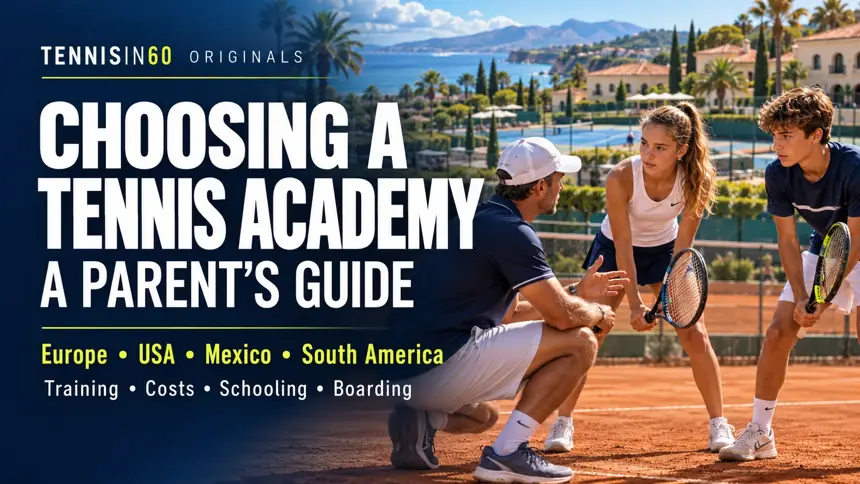
How much can a camp improve a young player? A parent’s guide to 20 programmes across Europe, the United States, Mexico and South America, comparing training, player-development records, costs, schooling, housing and meals.
An academy can change a young player’s tennis. It can provide better practice partners, more purposeful coaching, regular competition and a daily environment in which improvement matters. It can also consume a family’s savings without delivering the progress the brochure seemed to promise. The difference usually comes down to the fit between the child, the coach, the training group and the life surrounding the tennis.
For a parent choosing an academy, the starting point is a question more practical than which academy has the most famous name. What, specifically, is preventing this player from improving at home? A weak second serve, a shortage of suitable opponents, insufficient tournament experience and an incompatible school timetable are different problems. They may require different solutions. Sometimes the answer is a residential academy. Sometimes it is a short training block and a better local plan.
This guide examines established names and relevant alternatives in Europe, the United States, Mexico and South America. It considers coaching records, costs, schooling, accommodation and meals, while separating a supervised boarding programme from a tennis centre that happens to sit beside a hotel. Those distinctions matter more than a photograph of a champion leaning against a fence.
Programme research and price references were reviewed on October 24, 2026; this comparison was edited on October 25. Prices retain their original currency and stated season. They are reference figures, not live quotations. Where a comparable current total could not be verified, the guide says so. Programme descriptions come from the linked providers; this is desk research, not a report of personal campus inspections.
The recommendations are editorial judgements about family circumstances, not an audited ranking of coaching quality. There is no independent dataset showing that a particular academy improves every type of junior more than its competitors. A successful professional connection is relevant evidence of experience, but it does not tell a parent the probability that an ordinary fee-paying student will reach college tennis or the professional tour.
Our starting recommendation is to buy information before buying a year. Arrange an assessment, choose a short trial that resembles the intended programme, obtain an itemized budget, and agree how progress will be measured. The right academy should be comfortable explaining what it can provide, who will coach the child and what remains uncertain.
Academy comparison: location, programme and costs
Use this table to select enquiries, then read the profiles for context. Inclusion is not an endorsement or a ranking. The figures cover different products and periods: compare school, meals, supervision, competition and travel before comparing totals.
| Academy | Location | Programme to investigate | School and accommodation | Published price or next step |
|---|---|---|---|---|
| Rafa Nadal Academy | Manacor, Spain | Integrated tennis and school campus | Residential pathway; confirm package | Current annual quote required [2] |
| Mouratoglou Academy | Biot, France | Tennis with academic pathways | Residential options; confirm school and board | Individual quote [3][4] |
| Ferrero | Villena, Spain | Competition training; annual or short stay | Summer accommodation and full board listed | €1,720/week, summer 2026 reference [5][6] |
| Emilio Sánchez | Barcelona, Spain | Tennis with American-school option | Confirm combined school and residence package | Current combined quote [7][8] |
| Piatti | Bordighera, Italy | Specialist assessment and training | Guest accommodation is not automatically supervised junior boarding | Personalized quote [9][10] |
| Vilas | Mallorca, Spain | Junior high-performance training | Full-board junior option from age 13; confirm dates | From €1,389/week [11] |
| IMG | Bradenton, Florida, USA | Integrated sports boarding school | Request tennis-specific school and boarding total | Current quote required [12] |
| Evert | Boca Raton, Florida, USA | Academy or Developmental programme | Boarding available; school separate | US$55,650 or $67,950, 2026–27 [14] |
| Weil | Ojai, California, USA | Full-time tennis and school | Base combines training, boarding, school and team fee | US$68,600, 2026–27; extras apply [15] |
| Smith Stearns | Hilton Head Island, South Carolina, USA | Specialist day or housing programme | School separate; annual reference covers nine months | US$56,000 all-day housing; $2,095 weekly housing [16] |
| Saviano | Davie, Florida, USA | High-performance training with education partners | Confirm school and living arrangements separately | Individual quote [17][18] |
| Saddlebrook | Near Tampa, Florida, USA | Preparatory school and tennis | Request current school, residence and supervision details | 2025–26 figure is historical; obtain current quote [25] |
| Newcombe | New Braunfels, Texas, USA | Year-round academy and camps | Confirm current residential and school package | Current quote [26] |
| Rick Macci | South Florida, USA | Assessment and focused training blocks | Confirm housing and schooling; camp listing alone is insufficient | Current quote [27] |
| Rafa Nadal Tennis Center | Costa Mujeres, Mexico | Accompanied tennis and resort stay | Hotel package is distinct from Mallorca's school | Tennis and hotel breakdown required [19] |
| Mouratoglou Tennis Center | Guadalajara, Mexico | Junior and competition programmes | Residential and education arrangements need confirmation | Current itemized quote [20] |
| ADK | Itajaí, Brazil | High-performance training | Confirm junior school, housing and supervision | Current itemized quote [21] |
| Kirmayr | Serra Negra, Brazil | Prep School and training-camp pathways | Confirm school partnership and boarding inclusions | Individual quote [22] |
| Tandil Tenis / Sport Summa | Tandil, Argentina | Individualized advanced training pathway | International supervised boarding not verified here | Current quote and accommodation details [23] |
| Rio Tennis Academy | Rio de Janeiro, Brazil | Possible accompanied short training stay | Older programme listing; current junior offer needs confirmation | Current availability and quote required [24] |
How much better can a camp make a player
There is no defensible universal answer such as one week makes you twenty percent better. Improvement has several dimensions. A child may learn a more efficient service action without immediately serving more accurately in matches. Another may leave with the same strokes but better positioning, a clearer match plan and stronger habits between points. Those changes are meaningful, although they require different measurements.
A short camp is particularly well suited to diagnosis. A fresh coach may identify a movement pattern or decision that has become invisible through familiarity. The player can practise a correction repeatedly and discover how it feels. However, a correction introduced during a supervised drill still has to survive a returner, a score, fatigue and the player’s normal training environment.
An academy year creates a longer opportunity to develop those habits. It also changes more than coaching: opponents, schedules, surfaces, education, friendships and family contact. If a player improves, it is difficult to isolate which change caused the gain. If results deteriorate, the explanation may be a stronger tournament schedule rather than worse tennis. Parents need to interpret the evidence rather than simply collect it.
A six-week study of 20 young male players, with a mean age of about 13.6, reported an average relative improvement of 7.98% on an International Tennis Number assessment. It measured tennis-specific test performance, not an eight-percent improvement in every aspect of competition. It did not compare commercial academies or establish what a one-week camp delivers. Use it as an example of measurable training gains, not a forecast for your child. [1]
That distinction should shape every conversation with admissions staff. Ask whether the academy measures technical execution, drill performance, physical capacity, competitive results or some combination. A video showing a cleaner forehand is evidence of a technical change. It is not yet evidence that the player wins more points with that forehand against a comparable opponent.
A measurement plan a family can actually use
Choose two or three priorities rather than testing everything. For a developing tournament player, those might be a dependable second serve, better depth from a neutral position and more appropriate choices when stretched wide. Write the goals before the camp. Otherwise, it becomes too easy to declare whatever improved to have been the original purpose of attending.
For serving, use comparable numbers of attempts from both service courts. Record placement and pace together. A higher percentage achieved by slowing every serve into an attackable delivery is not necessarily improvement. A faster serve that produces many more double faults may not help either. The useful outcome is a delivery that remains effective at an acceptable risk under the conditions the player faces.
For groundstrokes, use both a repeatable feed and live points. The feed helps assess contact and control; points show whether the player recognizes when to attack, defend or reset. Record the task, target areas, ball type, surface and approximate conditions. Without that context, two scores may describe different tests rather than a genuine change in ability.
For movement, film the whole point rather than only contact. Watch the initial response, spacing, balance and recovery. A child who hits a better backhand but repeatedly recovers into the wrong position still has a problem to solve. The assessment should connect the stroke to the next action, because tennis rewards sequences rather than isolated poses.
For match play, track a small set of useful measures across several matches. Examples include double faults per service game, second-serve points won, returns put into play and errors when a neutral rally becomes uncomfortable. Define categories consistently. Two observers can label the same missed shot differently, so a family spreadsheet needs simple rules rather than an illusion of scientific precision.
Treat the following numbers as an illustration, not a promise or a standard every child should meet. A player might improve second-serve target accuracy from 48 of 80 attempts to 58 of 80, with similar pace, and retain 56 of 80 a month later. That is stronger evidence than one excellent final basket. It becomes more persuasive when double faults also decline across comparable match situations.
The child’s own understanding belongs in the assessment. Ask the player to explain the change without repeating a slogan. When does the new pattern help? What should happen when the opponent changes direction? What can the player do when nervous? An explanation that connects perception and action is a better sign of learning than memorizing several technical commands.
Request a written handover for the home coach. It should identify the priority, the reason for it, the drills used, the match situation it addresses and the next review date. This need not be a long report. A clear page and a few labelled video clips can prevent weeks of contradictory instruction after the player returns.
Decide what kind of programme you are buying
A holiday camp may prioritize enjoyment, social experience and broad skill development. That is a legitimate product. A high-performance trial should offer a more demanding training group, individualized objectives and relevant point play. A residential school programme adds education and pastoral responsibility. These products can share a brand while serving very different purposes.
Do not assume that staying in a hotel on an academy property means a child is enrolled as a supervised boarder. Equally, a training centre may work exceptionally well for a player accompanied by a parent while being unsuitable for an unaccompanied minor. Ask who is responsible from the end of afternoon practice until the next morning, including weekends and tournament days.
A full-time day academy can be a useful middle course. The child trains intensively while living with family or an agreed guardian. The family retains more direct oversight, but housing, transport, food and schooling remain separate responsibilities. A lower tennis invoice can therefore coexist with a substantial total cost.
For a younger child, A family could usually prefer a short accompanied experience before considering a major relocation. For an older, self-motivated competitor whose home environment has clear limitations, a longer trial may be reasonable. The decision should reflect demonstrated readiness, rather than the belief that leaving home proves seriousness.
Read academy success stories carefully
An academy may have developed a future professional for years, provided occasional training blocks, hosted an established tour player or employed a coach who worked with that player elsewhere. All four connections can be genuine. They do not describe the same contribution. Parents should ask the academy to explain which relationship applies to each success story it uses.
Selection also complicates comparisons. A centre admitting already exceptional juniors will naturally show impressive outcomes. Another may develop a broader range of players and produce fewer famous names while doing excellent work. The missing information is often the denominator: how many students entered, at what level, for how long and with which goals?
Ask for examples resembling your child. A fourteen-year-old regional competitor considering college tennis needs information about similar students, not only a junior Grand Slam champion. Request starting levels, length of attendance, educational outcomes and reasons some students left. Individual details may require family consent, but the academy should be able to discuss the pattern responsibly.
Europe offers several different academy models
Europe is not a single tennis product. A residential campus in Mallorca, a training centre on the Italian Riviera and a competition programme near Barcelona may offer different surfaces, schooling arrangements and daily routines. Travel between tournaments can also become a major part of the experience. The right question is which environment serves the child’s present stage, not which country supposedly produces the toughest players.
Rafa Nadal Academy in Manacor Spain
The Mallorca academy is an obvious starting point for families seeking an integrated campus. Its annual programme advertises tennis, physical preparation, an American-curriculum school, a supervised residence option and meals. It also describes tournament planning and periodic evaluations. Its own materials identify Alex Eala as an annual-programme example and list other associated players, including Casper Ruud. Those relationships should not be treated as identical developmental histories. [2]
A reason to consider it is the opportunity to assess tennis, education and residential life together. A family can ask how those departments coordinate when a player travels or struggles. That integration is potentially valuable for a teenager moving away from home, provided the actual group and assigned coaches fit.
A comparable current annual total was not verified for this guide. Request separate figures for training, school, residence, meals, tournament expenses and optional services. Do not transfer the price of an adult holiday or a visiting junior camp onto the annual school programme.
Mouratoglou Academy in Biot France
The French Riviera campus is another internationally recognized option. Its academic material describes schooling and boarding, with fees depending on the educational stream. The organization identifies connections with Coco Gauff, Stefanos Tsitsipas and Holger Rune, including foundation beneficiaries and ambassadors. A parent should distinguish those arrangements from the programme available to a new fee-paying student. [3][4]
A family could shortlist it for a motivated player whose family wants to compare an international training environment with a substantial education offering. The useful trial is the one that resembles the proposed school-year group, rather than a holiday week selected primarily for convenience.
Current annual costs require an individualized quote. Clarify the French or American educational route, residence, weekend provision, meals and competition travel. Nice-area access may be convenient for some European families, but travel from another continent adds cost and makes spontaneous visits harder. A family could compare the complete arrangement with a smaller academy before assuming the larger brand is the better investment.
Ferrero Tennis Academy in Villena Spain
Ferrero’s academy has a particularly relevant coaching story: its official material identifies Carlos Alcaraz and Pablo Carreño among players associated with its training model. The annual and short-stay competition programmes describe an environment built around tennis development. That is useful evidence of high-level coaching experience, although it does not promise personal instruction from Juan Carlos Ferrero. [5]
The academy published a 2026 Summer Stage rate of €1,720 per week, including accommodation, full board and training, with listed extras such as laundry, stringing and external tournament expenses. Those summer dates have passed. The figure is a historical comparison point, not a confirmed 2027 booking price or an annual-school quotation. [6]
A reason to consider Villena is a purposeful competition block for a child already comfortable with demanding practice. A family could ask how much live point play is included and what happens when the player’s level differs from the group’s advertised standard.
Emilio Sánchez Academy in Barcelona Spain
The Barcelona operation is relevant for families comparing tennis with an American educational pathway. Academy and school materials describe the connection between tennis programmes and the Emilio Sánchez American School. Residential and camp options exist, but the exact package needs to be matched to the child’s age and period of attendance. [7][8]
A family could consider Barcelona for a junior seeking a structured school-and-tennis arrangement while experiencing a different training culture. A family could not assume that every programme uses the same coaches, timetable or educational provision. Ask admissions to explain the specific route proposed for your child.
Piatti Tennis Center in Bordighera Italy
Piatti is a different proposition from a large residential school campus. Its public material describes resident and consulting programmes, specialist support and a Club House with hotel and restaurant facilities. Riccardo Piatti’s official biography states that he coached Jannik Sinner from thirteen to twenty. That is a concrete coaching relationship, not evidence that Sinner’s later success belongs entirely to one institution. [9][10]
A family could investigate Piatti for a technically focused assessment, a carefully selected training block or an advanced player seeking a particular coaching environment. The key question is access: who will evaluate the player, who will teach the sessions and how often will the plan be reviewed?
Vilas Tennis Academy in Mallorca Spain
Vilas provides another Mallorca option for comparison. Its published junior high-performance booking page lists a full-boarding programme from €1,389 per week, with boarding available from age thirteen. Listed inclusions include shared accommodation, three meals and airport transfers. A starting rate is not a fixed price for every date, room or individual requirement. Confirm the destination and selected programme before paying. [11]
United States choices for college and competitive development
American academies can be especially relevant when a family is exploring college tennis, but an American address does not itself create a scholarship pathway. The school transcript, competitive level, coach communication and university fit still matter. Compare campuses by how they support those tasks, and avoid treating a general college-placement claim as a guarantee of a roster place or financial award.
IMG Academy in Bradenton Florida
IMG is one of the best-known names in residential sports education. Its tennis programme has a long institutional history; the WTA’s account of Maria Sharapova’s development describes her move to Bradenton and training with Nick Bollettieri. Historical alumni are evidence of experience, but they do not identify the coach a new student will receive today. [12][13]
A family could consider IMG for a family seeking to examine a large, integrated boarding-school and sports environment. The question is whether the breadth of services translates into a coherent plan for this particular student. Ask how academic staff, coaches and residential staff share concerns.
A current comparable tennis quotation was not independently verified here. Several online directories mix day and boarding figures, different grades or different academic years. Rather than repeat a potentially misleading range, request IMG’s official rate card for the intended year, grade and tennis programme, plus mandatory fees and exclusions.
Evert Tennis Academy in Boca Raton Florida
Evert publishes unusually useful programme distinctions. For 2026–27, its Academy programme lists US$55,650 boarding and US$36,150 non-boarding; the Developmental programme lists US$67,950 and US$48,950 respectively. School tuition is separate. Boarding includes accommodation and three meals, while specified holiday periods are excluded. The academy also requires a prospective boarder to complete a one-week campus stay. [14]
Weil Tennis Academy in Ojai California
Weil’s 2026–27 published schedule separates US$46,000 for training and boarding, US$22,000 for school and a US$600 team fee, producing a listed US$68,600 base total. It also identifies a US$7,000 tournament travel expense account, a US$500 international student visa fee and a one-time US$7,500 college-placement fee for grades eleven and twelve. The meal description specifies three meals Monday through Friday, so ask about weekends. [15]
The decision should centre on the relationship between school, competitive planning and coaching. Ask for current placement examples relevant to the student’s level, and for an explanation of how tournament expenses are authorized and reconciled. Geographic convenience can make parental involvement easier, but it cannot replace a suitable training group and a convincing plan.
Smith Stearns in Hilton Head Island South Carolina
Smith Stearns publishes 2026–27 nine-month rates of US$56,000 for its all-day housing option and US$32,000 for all-day day students. The afternoon-only figures are US$47,000 with housing and US$25,000 for day students. Weekly camp tuition is listed at US$1,195, or US$2,095 with housing. Private lessons, tournament coaching and school tuition are separate. Confirm all applicable fees and meal arrangements directly. [16]
A family could consider it when the family wants to compare a specialist tennis environment with the larger multisport model. The afternoon option may also be relevant when education follows a more conventional schedule, provided the transport and total workload are workable.
Saviano High Performance Tennis in Davie Florida
Saviano provides an important alternative to the boarding-campus model. Its own material describes full-time training paired with education partners, including Laurel Springs and ICL Academy, and states that academy tuition is available by enquiry. Schooling and tennis are separate purchases. Nick Saviano’s public coaching history includes work with Sloane Stephens and Eugenie Bouchard. [17][18]
A family could investigate it for a family able to manage living arrangements and interested in the specific coaching approach. The relevant comparison is not tennis tuition against a boarding school’s entire package. It is tuition plus accommodation, meals, school, transport and adult supervision.
Saddlebrook Academy near Tampa Florida
Saddlebrook belongs on a parent’s established-name comparison list. Its preparatory school describes an integrated academic and tennis programme, and its boarding page identifies condominium accommodation on the resort grounds. The publicly reviewed tuition page still labels its combined US$76,915 tennis, academics and boarding figure as 2025–26. Treat that as a previous-year reference and request the current quotation. [25]
A reason to investigate is the combination of education and training in one established setting. Ask how the residential arrangement works for the child’s age, who supervises each unit and how weekends differ from school days. A resort setting does not answer those questions by itself.
John Newcombe Tennis Ranch in New Braunfels Texas
The Newcombe Ranch offers a long-established tennis setting in the Texas Hill Country, with year-round academy and camp programmes. Its academy material also discusses local schooling options. The current combination of education, residential supervision, food and training should be confirmed for the particular student rather than inferred from an overnight camp description. [26]
A current comparable annual total was not verified here. Request the full residential quotation, education costs, meals, transport and tournament coaching. Ask how staff handle a player whose needs change during the year. The founder’s name may introduce the programme, but the day-to-day relationships determine whether the child improves and enjoys being there.
Rick Macci Tennis Academy in South Florida
Rick Macci is another established coaching name worth investigating, particularly when the family wants a specialist technical opinion. The academy’s current website markets instruction and holiday programmes, including boarding and non-boarding options for certain camps. That does not establish one uniform annual residential-school package. [27]
A family could request a tightly defined assessment or training block before considering a larger commitment. Specify whether the booking is with Macci personally or another coach, how many hours are included and what written or video feedback will be supplied.
Current programme fees, housing, meals and school arrangements require direct confirmation. A named coach’s private instruction should not be compared with a group academy rate without adjusting for the service. For a child with a specific technical problem, a specialist consultation can be worthwhile; it still needs coordination with the person responsible for training when the child returns home.
Mexico requires a distinction between camps and boarding academies
Mexico can be attractive for a North American family seeking a shorter journey, a Spanish-language experience or a tennis block attached to a holiday. However, the two programmes below should not be represented as equivalent to a long-established residential school merely because their brands are internationally famous. Their local programmes and outcomes must be assessed on their own evidence.
Rafa Nadal Tennis Center in Costa Mujeres Mexico
The Costa Mujeres centre near Cancún advertises junior coaching and family packages associated with the Grand Palladium resort. Its programmes use the Nadal methodology, but the centre is not the same institution as the residential academy in Mallorca. The official junior material describes training and grouping; it does not establish a like-for-like annual boarding-school package. [19]
A family could consider it for an accompanied short stay, especially when a family wants to test whether a child enjoys a more concentrated tennis routine. Parents can remain involved and compare the coaching experience without changing schools or committing to a year abroad.
Request tennis and hotel prices separately, or an exact package breakdown if booking them together. Confirm whether the child’s meals are supplied by the tennis programme or the hotel, who supervises between sessions, and what happens on days without scheduled coaching. Resort accommodation is not automatically supervised junior boarding.
Mouratoglou Tennis Center in Guadalajara Mexico
The Guadalajara centre operates at the Centro Panamericano de Tenis. Its official page lists junior development, high-competition training and camps, including a high-competition summer option for ages ten to eighteen. These offerings make it relevant to a Mexico-based family or a visiting player exploring a focused block. They do not establish a long local record equivalent to the French academy’s history. [20]
The first questions should concern the actual competition group, the coaching team and the availability of relevant matches. For a regional or national junior, daily access to suitable opponents can matter more than whether the venue once hosted professional tennis.
No comparable current all-inclusive residential price was verified. Ask about training, accommodation, food, schooling and transport separately. Unless written information confirms supervised boarding for the intended age, plan it as an accompanied or locally supported arrangement.
South America can offer valuable alternatives
South America deserves more than a passing reference to inexpensive clay-court training. The region contains experienced coaches and serious tennis environments, but families must investigate each specific programme. English-language information can be limited, published totals can be difficult to compare, and accommodation may involve a separate provider. None of those facts proves poor quality; they make direct verification more important.
ADK Tennis in Itajaí Brazil
ADK’s official material identifies a high-performance operation associated with Itamirim Clube de Campo in Itajaí, Santa Catarina, and describes more than twenty years of development work. Its public intensive-training information includes on-court work and physical preparation. [21] That makes it a relevant Brazilian programme to investigate, particularly for a player seeking an organized competitive environment.
A family could request a current profile of the proposed group, including age, playing level, language and tournament plans. Also ask for named examples of players developed over a substantial period. The academy’s operating history is useful, but should not be converted into an invented professional success rate.
Training, school, housing and full-board costs require direct confirmation. Ask whether the academy itself provides accommodation and supervision or introduces families to a separate arrangement. Establish responsibility for food, weekend transport and medical appointments.
Kirmayr in Serra Negra Brazil
Kirmayr’s official site presents a training centre, a Prep School pathway and a training-camp week designed to introduce the resident-athlete routine. It describes accommodation, food and supervision within its programme information and identifies a local school partnership. Carlos Kirmayr’s stated coaching history includes Gabriela Sabatini; that historical coaching relationship is distinct from a current student’s likely outcome. [22]
A family could investigate this option for a family seeking an education-and-tennis route in Brazil, especially when the child is interested in eventual university opportunities. Ask how the present academic programme serves international students and whether instruction and transcripts meet the family’s intended next step.
Current tuition, housing, meals and tournament charges require an individualized quotation. A college-placement claim should prompt questions about cohort size, institutions, actual roster participation and the net cost after any award. Do not read a headline percentage as a promise to your child.
Tandil Tenis through Sport Summa in Argentina
Sport Summa’s academy page describes Tandil Tenis as founded in 1997 by Marcelo Gómez and Mario Bravo. It outlines a progression from introductory training to high competition, with full-time work adapted to individual needs at the advanced stage. [23] This provides a more concrete starting point than simply recommending Argentina because it has produced famous professionals.
A family could ask the programme to identify the current training location, staff, available peer group and admission process. The public material reviewed did not provide a comparable current annual price, supervised international boarding package or sufficiently detailed outcome dataset for this guide to rank it by graduate success.
Rio Tennis Academy in Rio de Janeiro Brazil
Rio Tennis publishes programmes that include preseason training and accommodation possibilities. However, the detailed preseason description reviewed still referred to preparation for the 2025 season. That is not sufficient evidence of a currently available 2026–27 residential junior offer. Its social-camp accommodation description also should not be mistaken for a minor’s boarding-school contract. [24]
A family could include Rio as a possible accompanied short-stay enquiry, not a verified annual boarding recommendation. Ask whether the relevant junior programme is currently operating, which ages are accepted and who provides supervision. Obtain current dates and written prices before arranging travel.
What the published prices actually tell a parent
The available figures demonstrate why price comparisons need discipline. A weekly rate may cover coaching, meals and a bed but no tournament travel. An annual training-and-boarding figure may exclude school. A nine-month package should not be presented as twelve months of accommodation. Always compare the same dates, the same educational requirement and the same level of supervision.
| Programme | Published reference | Important qualification |
|---|---|---|
| Ferrero Summer Stage | €1,720 per week for summer 2026 | Past-season reference; obtain new dates and rates; listed extras apply |
| Vilas junior full boarding | From €1,389 per week | Starting rate; verify selected location, dates and age eligibility |
| Evert Academy programme | US$55,650 boarding for 2026–27 | School separate; specified holiday periods excluded |
| Evert Developmental programme | US$67,950 boarding for 2026–27 | Different training product; school separate |
| Weil full-time boarding base | US$68,600 for 2026–27 | Additional tournament account and applicable student or placement fees |
| Smith Stearns all-day housing | US$56,000 for nine months in 2026–27 | School, tournament coaching and private lessons separate |
| Smith Stearns weekly with housing | US$2,095 | Confirm meals, dates, coaching and cancellation conditions |
| Other academies in this guide | Request a current itemized quote | No comparable current all-inclusive total verified here |
These are source-based reference figures, not available inventory or binding quotations. The table deliberately avoids filling missing prices with directory estimates. The most useful next step is to send every shortlisted academy the same request, so each has to answer the same questions. [6][11][14][15][16]
For a Canadian family, calculate affordability in Canadian dollars after obtaining the quote. Keep the original currency beside the conversion and record the date and exchange rate used. Do not compare a euro price with a US-dollar price as though the numbers were interchangeable. Also establish the currency in which refunds and later instalments would be paid.
Ask whether an enrolment deposit is credited toward tuition or is additional. A family can accidentally count the same expense twice, or overlook a separate registration charge. Ask for a written schedule showing the amount due at acceptance, later payment dates and the remaining balance. Read cancellation and withdrawal terms before making the first payment.
School holidays deserve their own budget line. If the residence closes, the child may need flights, alternative accommodation or an adult to accompany them. A package can look economical until several unplanned travel periods appear. Ask for the complete calendar, not merely the first and last day of training.
Tournament accounts need similar scrutiny. Is the quoted amount a fee, an advance against expenses or a minimum contribution? Who approves additional travel? Are coach costs shared between players? What happens to an unused balance? A competition programme should connect the proposed events to the development plan rather than simply spend whatever is available.
Meals also need definition. Full board usually suggests breakfast, lunch and dinner, but families should confirm the actual service and days. Are snacks included? What happens after a late match or on an away tournament? Can the kitchen accommodate the child’s needs? Food provision affects the daily routine, so an attractive training schedule is incomplete without this information.
Build the family budget before choosing the brand
Start with the amount the family can comfortably sustain, not the maximum it can assemble for one exceptional year. Tennis development often requires continuity. If an ambitious first year removes the ability to fund later coaching or competition, the initial decision may weaken the longer-term plan. The child should not feel that every result must justify a family financial sacrifice.
Use separate categories for training, schooling, accommodation, meals, transport, tournaments, equipment and unexpected costs. Include the parent’s travel and time away from work where relevant. An accompanied stay can be excellent for a younger child but substantially more expensive than the academy invoice suggests.
Consider a purely illustrative four-week budget. Suppose training is quoted at 4,000 currency units, housing and meals at 2,000, travel at 1,200, competition at 600 and equipment or local transport at 400. The total is 8,200, not 4,000. These are invented planning figures, not market prices. Their purpose is to demonstrate the structure of the decision.
For a school-year example, suppose a base package is 60,000 units, school is 15,000, tournament travel is 8,000 and family travel plus personal costs is 7,000. The total reaches 90,000. Again, this is a calculation example, not an academy quotation. A lower base package can become the more expensive choice once equivalent services are included.
If the annual budget is limited, A family could favour a strong home base with a targeted trial abroad. Spend on the problem that actually blocks progress: a technical assessment, access to suitable opponents or supervised tournament experience. A well-planned two-week intervention can offer better value than a longer stay without clear objectives.
With a moderate budget, compare a day academy while living with family against residential options. The day model can preserve parental involvement and flexibility, but only if school and transport work. Do not assume a parent can simultaneously manage remote work, daily driving and tournament travel without a realistic schedule.
With a larger budget, the shortlist can include integrated campuses, but price should still be justified by services the child needs. A comprehensive package is not automatically efficient if the student uses only part of it. Ask which services are included, which are routinely delivered and which require additional bookings or charges.
A family could also protect a return-home budget. If the child becomes unhappy or the fit is poor, the family should be able to change course without treating the decision as a failure. A sensible exit plan supports a healthier trial because neither the child nor the parent has to pretend that an unsuitable arrangement is working.
Build a shortlist around the child's needs
For a young child who is still discovering competitive tennis, A family could begin close to home and use an accompanied camp as an experiment. The purpose would be to learn what the child enjoys, how they respond to unfamiliar instruction and whether a higher training volume remains positive. An early decision should preserve enthusiasm and future options.
For a committed teenager with a college goal, A family could compare the education-and-tennis arrangements first. Weil, Evert, Smith Stearns and the integrated European options provide different models to investigate. A family could ask each to explain the academic timetable, current placement support and the outcomes of students with a comparable starting level. The best fit might be the least disruptive option.
For an advanced junior with credible professional ambitions, A family could place more weight on the specific coach, training group and competition plan. Ferrero, Piatti and other specialist environments merit consideration on those terms. A family could seek an independent assessment from a coach who gains nothing financially from the move, and ask what evidence makes a professional pathway realistic.
For a North American family wanting a short winter block, Mexico may offer a practical accompanied option. The question is whether the chosen centre has the right group and enough purposeful coaching. A pleasant family trip and a serious training block can coexist, but parents should decide which objective takes priority when timetables compete.
For a family comfortable with Portuguese or Spanish and interested in a longer regional experience, Brazil or Argentina may deserve investigation. A family could not choose purely on expected savings. A family could compare the written residential arrangements, language support and competitive calendar with European and American alternatives, then visit before making a school-year decision.
Location is also a relationship question. How often can a parent visit without exhausting the budget? Can the child contact home at reasonable hours? Who can collect the child quickly if the arrangement fails? These are practical tests of the plan, especially when the student is younger or has never lived away from family.
Housing and schooling are part of performance
A good training session cannot compensate indefinitely for an unsuitable living arrangement. Ask to see the actual room category, not just a promotional photograph. Confirm the number and ages of roommates, bathroom arrangements, supervision overnight, room changes and the person the child can approach privately with a concern. Request the same information for tournament accommodation.
Boarding policies should explain ordinary life as well as emergencies. Who checks attendance after dinner? Can students leave the property? How are transport and weekend activities supervised? How are homesickness and conflict handled? Parents should receive clear reporting and escalation contacts. A reassuring answer names responsibilities rather than simply saying the environment is like a family.
For education, identify the actual school, curriculum and qualification. Ask who teaches, how missed work is recovered during travel and whether credits will transfer to the intended next school. A statement that academics are available is incomplete. The child needs a timetable, appropriate teaching and someone who notices when progress slips.
If American college sport is the goal, have the school and intended eligibility pathway checked directly against current requirements. An academy’s recruitment service does not remove the family’s responsibility to verify the student’s courses and records. Avoid assuming that an advertised school association makes every possible course selection suitable for every destination.
Discuss the child’s wishes away from admissions staff. Would they still choose the programme without a famous name on the gate? What are they worried about? What would make them want to leave? A genuine choice requires permission to express reservations. That conversation can reveal a poor fit earlier than another polished presentation.
Turn the trial into a decision rather than a holiday verdict
Before arrival, send recent match video, competitive history and the agreed objectives. Ask the academy to confirm that it can place the child appropriately. During the stay, observe whether coaches give feedback the player understands and whether practice includes situations connected to the goals. A crowded timetable is not the same thing as useful learning.
At departure, request a concise evaluation identifying progress, remaining limitations and a realistic next block. Compare it with the original objectives. Then allow the child time to return to ordinary training before making a large commitment. The immediate excitement of travel can make every academy feel like the answer.
Four to six weeks later, repeat the relevant assessment and review comparable match evidence. Speak to the home coach and the child separately before bringing their views together. If the change has lasted, that strengthens the academy’s case. If it has disappeared, investigate whether the issue was coaching, insufficient practice or a poor handover before deciding what to do next.
The strongest outcome is not necessarily admission to the most prestigious campus. It is a player who understands their game better, competes more effectively, remains engaged with school and wants to keep improving. For a parent, that is a more dependable return than the hope that proximity to champions will produce another one.
An academy should earn the next commitment through evidence. Start with the child’s needs, compare complete costs and measure what happens after the first visit. If the fit is right, expand the relationship deliberately. If it is wrong, use what was learned to improve the home plan. Either way, the family should leave with better information and the child’s future still open.
Before contacting academies, prepare one shared enquiry describing the player’s age, current level, goals, school year, preferred dates and maximum total budget. Ask every provider for the proposed coach, group standard, weekly timetable, accommodation, meals, schooling and tournament plan. Request a complete quotation with exclusions and cancellation terms, plus a sample progress report. Include the child in reviewing the replies. The clearest response is not automatically the best programme, but unclear answers are a reason to pause. Compare what each academy promises to deliver, then check those promises during the trial. Keep the final decision grounded in the child’s experience, not the parent’s excitement about the famous name.
Sources
- [1] Training study on ITN and physical fitness
- [2] Rafa Nadal Academy annual admission programme
- [3] Mouratoglou academic courses
- [4] Mouratoglou academy and player connections
- [5] Ferrero annual competition programme
- [6] Ferrero Summer Stage
- [7] Emilio Sánchez Barcelona intensive programme
- [8] Emilio Sánchez American School
- [9] Piatti Tennis Center programmes
- [10] Piatti coaching team and history
- [11] Vilas high performance junior programme
- [12] IMG Academy boarding school tennis
- [13] WTA account of Maria Sharapova development
- [14] Evert training and academics fees
- [15] Weil tuition and fees
- [16] Smith Stearns tuition and fees
- [17] Saviano training and school arrangements
- [18] Saviano coaching background
- [19] Rafa Nadal Tennis Center Costa Mujeres
- [20] Mouratoglou Guadalajara
- [21] ADK Tennis programmes and locations
- [22] Kirmayr programmes and accommodation
- [23] Sport Summa Tandil academy
- [24] Rio Tennis Academy programmes
- [25] Saddlebrook tuition reference
- [26] Newcombe year round academy
- [27] Rick Macci holiday camps
Originally published by Tennisin60. Original article text and sources preserved. Original publication ↗